In short
- Accounting software answers "what did we earn and spend?". An ERP also answers "what do we need to buy, make and dispatch?".
- Manufacturers usually outgrow accounting software in stock and production, not in finance.
- Moving to an ERP does not mean giving up your books. Accounting becomes one part of a larger system.
A common starting point
Most manufacturers start with an accounting package. It handles invoices, GST, ledgers and the balance sheet, and the CA is comfortable with it. For a while, production and stock are managed around it, in registers and spreadsheets.
The question usually comes up as the business grows: can the accounting software be stretched further, or is it time for an ERP? The honest answer depends on where the problems are.
What accounting software does well
- Sales and purchase invoices with GST.
- Receipts, payments and bank entries.
- Ledgers, outstanding balances and financial statements.
- Basic stock quantities and values, item by item.
It is designed around transactions that have a financial effect. That makes it the right tool for the books, and an incomplete one for the factory.
Where it runs out for a manufacturer
Manufacturing involves a lot of activity before anything reaches the accounts. Material is planned, requisitioned, received, inspected, issued, consumed and turned into a product. Most of these steps have no invoice attached, so accounting software has no natural place for them:
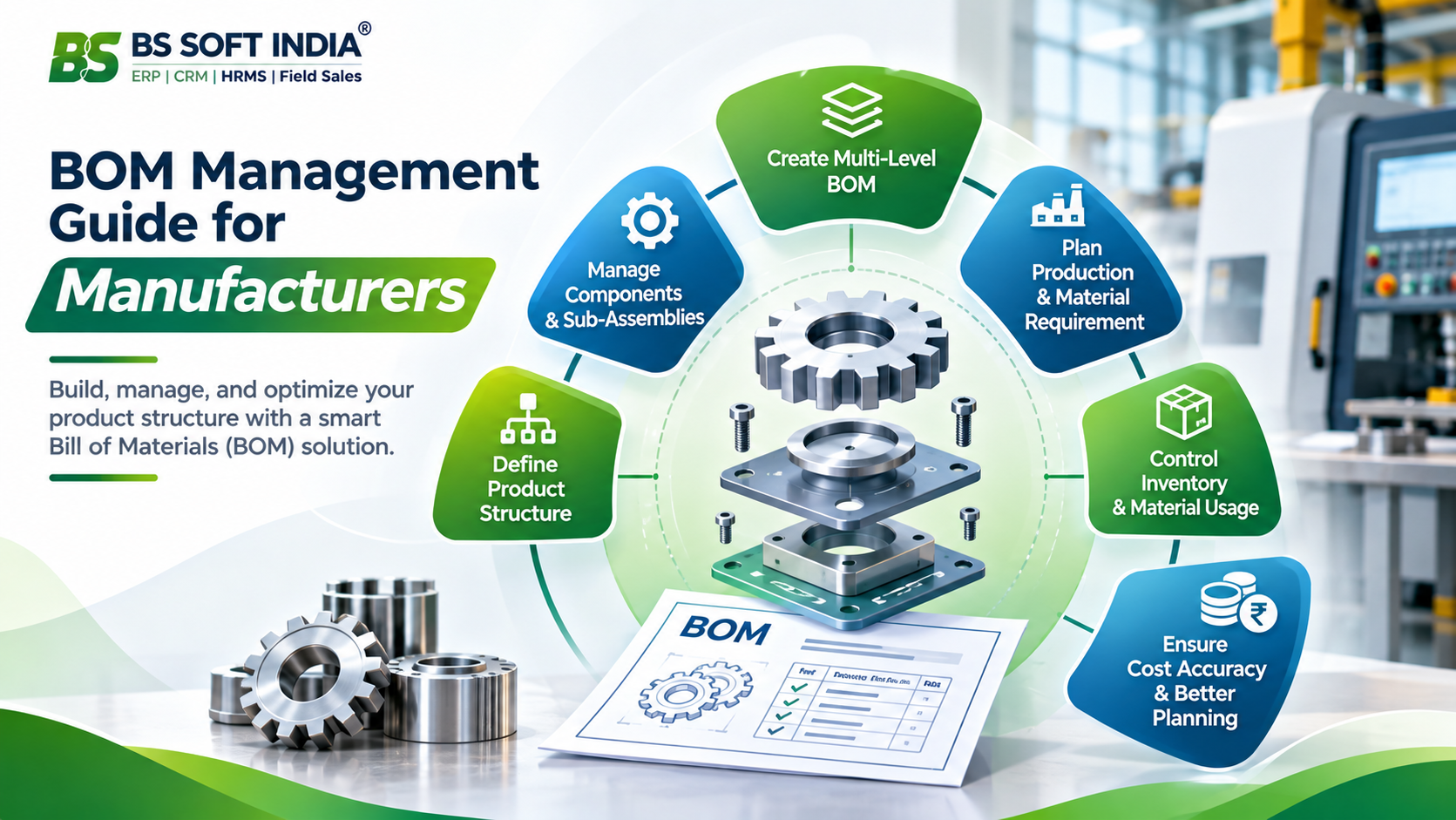
- Bills of Materials, so the system knows what goes into each product.
- Work orders and production stages.
- Material requirements and shortages for planned production.
- Quality checks on received goods, with accepted and rejected quantities.
- Material sent to job workers, and what is still pending with them.
- Enquiries, quotations and follow-ups before an order exists.
When these live outside the system, the stock figure in the accounts is only as good as the last time someone updated it by hand.
Side by side
A rough comparison. Individual products differ, but the pattern holds for most of them:
What did we sell and buy?
- Accounting software
- Yes
- Manufacturing ERP
- Yes
What do we owe, and what are we owed?
- Accounting software
- Yes
- Manufacturing ERP
- Yes
What is in stock, and where?
- Accounting software
- Usually totals only
- Manufacturing ERP
- By warehouse and status
What material does this order need?
- Accounting software
- No
- Manufacturing ERP
- Yes, from the BOM
What is short for this week's production?
- Accounting software
- No
- Manufacturing ERP
- Yes
Which quotations are waiting for a decision?
- Accounting software
- No
- Manufacturing ERP
- Yes, with CRM
What is pending with job workers?
- Accounting software
- Rarely
- Manufacturing ERP
- Yes
How to decide
If your problems are mainly about the books, such as GST returns, reconciliations or outstanding payments, making better use of your accounting software may be enough. If they are about material, production and delivery dates, an ERP deals with the cause rather than the symptom.
A useful test: trace one recent order from enquiry to payment. Count how many times the same information was typed in, and how many spreadsheets were involved along the way. The number tells you more than any feature list.
Finance inside BS SOFT's ERP
In BS SOFT's ERP, Finance & Accounting is one of the connected solutions rather than a separate package. Ledger accounts, sales and purchase transactions, receipts, payments, journal vouchers, outstanding balances and financial reporting work alongside sales, purchasing and inventory, and the solution supports GST billing, E-Invoice generation and E-Way Bill services.
The books are still kept, but they are fed by the same records that run purchase, stock and production, instead of being typed in again at month-end.