In short
- A GST invoice is a tax document as well as a bill. Getting it right first time saves corrections in your returns later.
- E-invoices and e-way bills start from the same invoice data, so it should be entered only once.
- Thresholds and rules change. Confirm what applies to your business with your CA.
Billing is more than printing an invoice
For many small businesses, billing starts as a Word or Excel template. It looks fine until month-end, when someone has to work out tax totals, match payments to invoices and chase outstanding amounts from three different files.
GST billing software keeps sales and purchase entries, receipts and payments in one place, calculates tax on every invoice and keeps the history of each transaction. Ledgers, outstanding reports and GST summaries then come from those same entries instead of being rebuilt by hand.
What goes on a GST invoice
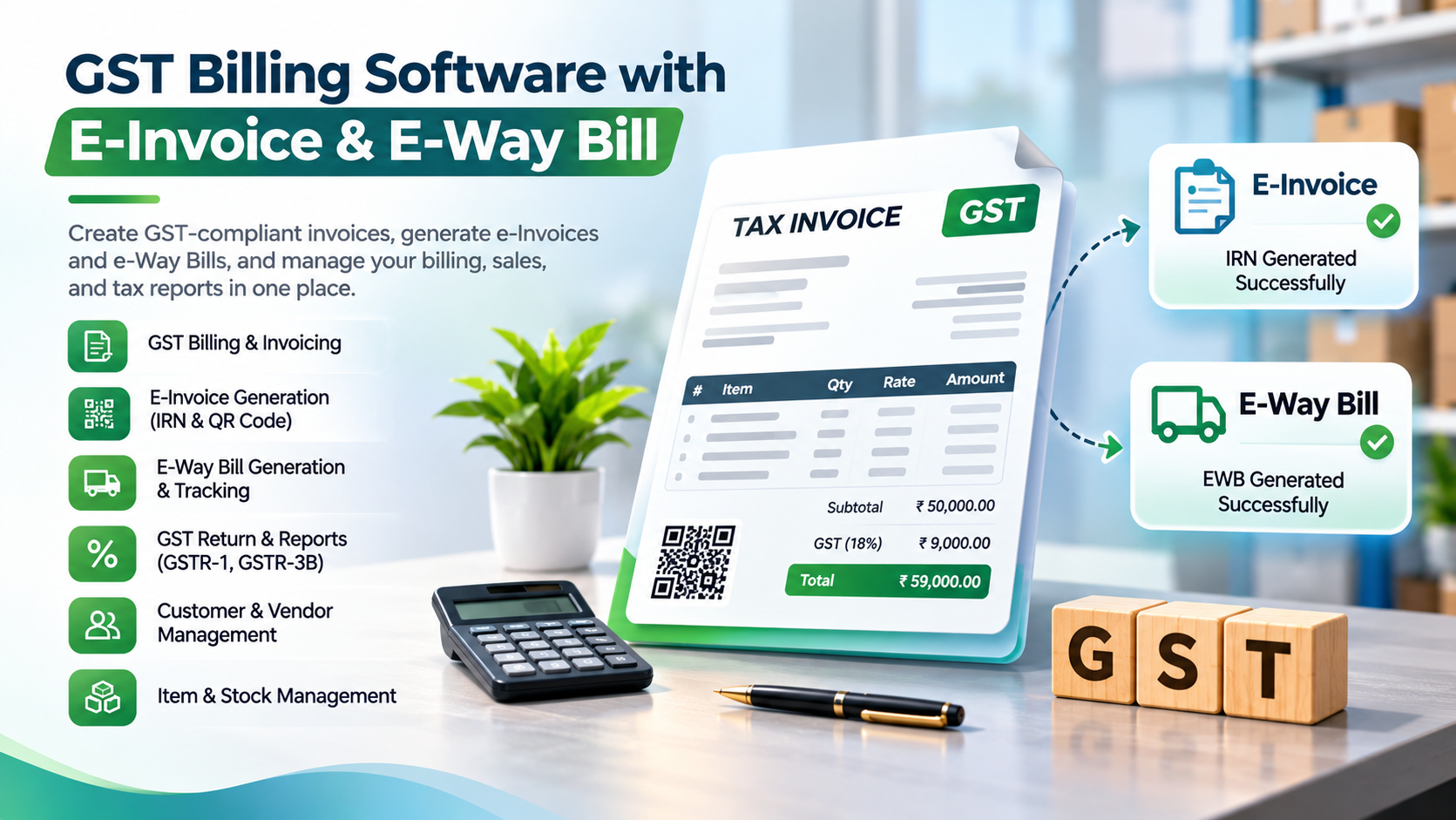
A tax invoice under GST needs more than an amount and a signature. The usual details include:
- Your GSTIN and, for business customers, the customer's GSTIN.
- An invoice number and date, in a consistent series.
- The HSN code for goods or the SAC code for services.
- The place of supply, which decides whether CGST and SGST apply (within the state) or IGST (between states).
- The taxable value, tax rate and tax amount for each item.
Good billing software picks most of this up from the customer and item masters, so whoever makes the invoice is not typing GSTINs and tax rates each time. That is where most errors come from.
How e-invoicing works
With e-invoicing, the invoice details are reported to the government's Invoice Registration Portal (IRP). The portal validates them and returns an Invoice Reference Number (IRN) and a signed QR code, which appear on the invoice. The same data also flows into the GST return system, which cuts down retyping and mismatches between invoices and returns.
E-invoicing applies to B2B invoices of businesses above a turnover threshold that has been lowered in stages; since August 2023 it has been ₹5 crore of aggregate turnover. Thresholds and reporting time limits are revised from time to time, so check the current position with your tax advisor.
Where the e-way bill fits
An e-way bill is needed to move goods above a set consignment value, generally ₹50,000, with some state-specific rules. It has two parts: Part A with the invoice and goods details, and Part B with the vehicle details. How long it stays valid depends on the distance the goods travel.
If the invoice is already in the system, the e-way bill is mostly a matter of adding transport details. Where e-invoicing applies, the e-way bill can be generated from the same invoice data, so nothing is entered twice.
What to check before choosing billing software
- Can the invoice print format be changed to match your layout, logo and terms?
- Does it handle both sales and purchase entries, as well as receipts and payments?
- Are ledger and outstanding reports available without exporting to Excel?
- Is E-Invoice and E-Way Bill generation supported in the configuration you are buying?
- Who do you call when the government changes a format or a rule?
Billing in BS SOFT
BS SOFT INDIA provides billing solutions that support sales and purchase entries, GST-related workflows, receipts, payments, ledger reports, outstanding reports and invoice print customization. Supported solutions can also integrate E-Invoice generation and E-Way Bill services to help businesses manage applicable electronic documentation.
The available functionality depends on the software configuration and supported integrations, so it is worth walking through your own invoice types during the demo: sales, purchase, job work and branch transfers, if you have them.